· Updated · Cristian Darie · Law · 13 min read
Branch Office in Romania
Open a branch office in Romania from €899: the Trade Register documents, branch vs. subsidiary and branch taxation in 2026, explained by our lawyers.

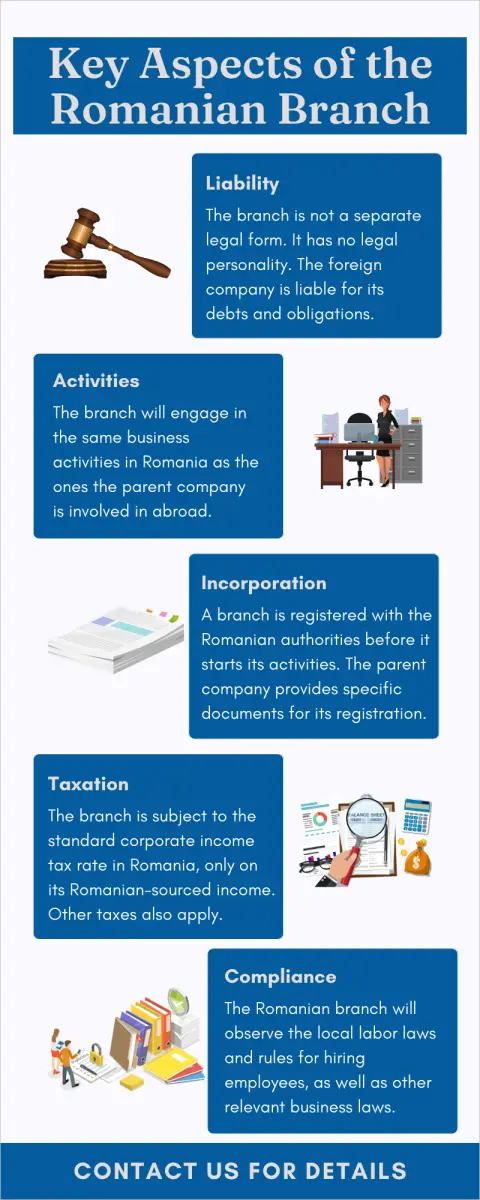
As opposed to the status of subsidiaries, the branch is just an extension of the parent company and therefore has no legal personality and no independence. Under the Romanian Civil Code, the organic statute of a branch is governed by the national law of the parent company that set it up. Consequently, if intending to establish a Romanian branch, clients should be informed that this business entity remains dependent on the mother company at the economic level. A branch is a secondary unit that must be commercially equipped by the main company in order to conduct an activity falling within the objects of the parent company.
Branch office in Romania from EUR 899
Includes the Trade Register fees. Additional services are quoted separately.
| Quick Facts | |
|---|---|
| Applicable legislation (home country/foreign country) | Local |
Best Used For | Expanding the same business activities performed by the parent company to Romania |
Minimum share capital for the company branch in Romania (YES/NO) | No |
| Time frame for the incorporation (approx.) | 3 or more business days |
| Documents to be filed by parent company | Registration form, proof of fiscal registration in Romania, the parent company's constitutive documents, documents emplowering the branch representatives and their IDs, proof of registered office in Romania, the parent company's financial situaion, other documents and local authorizations (for branches in regulated fields) |
| Management (Local/Foreign) | Foreign |
| Legal representative required (YES/NO) | Yes |
| Local bank account (YES/NO) | Yes |
| Independence from the parent company | No |
| Liability of the parent company | The parent company is fully liable for the debts and obligations incurred by the company branch in Romania |
| Corporate tax rate in Romania | 16% |
| Annual accounts filing requirements | Yes |
| Possibility of hiring local staff in Romania (YES/NO) | Yes |
| Travel requirements for incorporating branch/subsidiary (YES/NO) | No |
| Double tax treaty access (YES/NO) | No |
| Business activities the branch can engage in | The same as the parent company |
| Industries in which the branch is used | Banking and financial services, IT and software, pharma, etc. |
| Mandatory branch name requirements | The same as the parent company's |
| Branch name restrictions | As applicable in Romania |
| Branch Memorandum and Articles of Association | The branch does not have its own constitutive documents. |
| Other documents | Information about the parent company, the branch representative in Romania, details about the parent company's financial situation (as applicable), etc. |
| Mandatory document translations | In Romanian |
| Legal capacity | The branch does not have legal capacity |
| Procedural capacity | No |
| Judicial capacity | No |
| Minimum number of employees | Not applicable |
| Can the representative office be used instead of the branch? | No, the representative office cannot be used for trading |
| Mandatory foreign company size | No, however, public limited companies are the ones to expand through a branch. |
| When to contact us for branch creation | Once the Board of the foreign company has decided to open a branch in Romania |
| Other services offered by our team | Subsidiary and local limited liability company/micro-company incorporation, other services for investors in Romania. |
Establish Romanian Branch - Key Elements
The process to set up a branch in Romania in 2026 requires this business unit to be registered with the National Trade Register. The mother company is entirely liable for all actions of managers and other employees of the branch. Representatives of the branch can conclude contracts even if this type of unit does not have a legal personality. It is still authorized to conclude transactions on behalf of the parent company. Thus, a legal document signed by the branch is legal action on behalf of the parent company.
All foreign entities that decide to open a company branch in Romania should also know that the setup process follows the main steps mentioned for the subsidiary. The dossier does not contain Articles of Association of the branch, as the branch has none of its own. The most important documents to be added include the articles of incorporation of the parent company, with a legalised Romanian translation, a certificate issued by the register in which the parent company is registered attesting its existence, and documents showing the parent company's registered office, object of activity and subscribed capital.
As this brief presentation showed, in order to open a company branch in Romania in 2026, certain procedures need to be followed and, in some cases, foreign investors may require specialized assistance, given the language barrier and the bureaucratic procedures. Our company developed accurate approaches able to guarantee favorable final results. Our experts can assist any client willing to establish a Romanian branch explaining rigorously each phase of this process and delivering optimal solutions for all particular cases.
According to Romanian legislation, branches are secondary offices of a company and have no legal personality of their own. A branch must be registered with the Trade Register before it starts its activity.
In order to open a branch in Romania you will need to submit the following documents at the Trade Registry: a special declaration, a company decision and a document that proves your rights to use the space. Only after the branch has been registered with the Trade Registry, you can start your activity. If the branch will be opened in the same city as the company it will be registered separately at the same Trade Registry.
Opening a branch in Romania when the headquarters are in another European Country
In order to open a branch in Romania, if your headquarters is in a European country that is not an EU or EEA member state (for example Switzerland or the United Kingdom), you will need to submit at the Trade Registry the following documentation (for companies from EU or EEA member states, the parent company's articles of association, certificate of existence and financial statements are not required):
- The power of attorney
- Translated and authenticated copies of the Articles of Association of the company
- Documents related to the Romanian branch
- The decision of the company board to set up the branch, indicating the address, the activity object, and the person that represents the branch, including identification document and mandate limits
- Translated and authenticated copies or original affidavits of the person who will represent the branch that shows they have legal authorization for this position and their specimen of signatures
- Copy of Article of Registration, holographic certified by the applicant, the text must be translated by an authorized translator, the copy must be authenticated by a notary and signed by the translator as well
- Special attorney’s POA in original for the nominated person to handle the legal formalities
- The last financial situation of the company that is approved, verified or published according to the legislation of the state in which the company resides. The document must be authenticated by a notary, translated by an authorized person, and signed by the translator as well
- An original affidavit regarding operation authorization
Our team of experts who specialize in Romania company formation can help you prepare the documents for the branch and submit them to the authorities.
Opening a branch in Romania when your headquarters is based in Romania
For companies that have their headquarters based in Romania, the process is a bit easier. However, they are still required to present the following documents to the Trade Registry:
- The decision of the Associates’ General Assembly for setting up the branch which mush include the address, activity object, identification document of the person appointed to represent the branch and the mandate’s limits, all of this must be presented in original
- Registration Certificate of the company, certified copy
- Articles of Association, updated in a certified copy
- Evidence for the headquarters
- Evidence for approvals of the competent authorities to register (when required by the law) in certified copy
- Affidavit of the person representing the branch as proof that they meet the legal conditions for their position, certified and authenticated by a lawyer, in original
- Affidavit regarding authorization of operations
- Signature specimen of the person representing the branch, in original
- Special attorney’s POA (power of attorney) in original for the nominated person to handle the legal formalities
For a foreign company to be able to carry out its activities on the territory of Romania, it is necessary to open a branch or a representative office. In order to establish a branch, the following documents are required:
- Establishment Act and Certified Legal Status, along with all modifications to these documents
- Documents certifying the registered office of the foreign company, its object of activity and the value of subscribed capital annually for foreign companies that are not members of the EU or EEA (if this information is not included in the articles of association or status of the legal person )
- Certificate from the register where the legal person is registered, to certify its existence, certified translation
- The annual financial statements of the company, approved, verified and published in accordance with the law of the statute in which they have their registered office, subject to the formalities of advertising of Romanian legal persons
- Proof of branch office
- Annual financial statements, if the legal entity is not governed by the law of an EU or EEA member state (for companies from EU member states, the publication of the financial statements in their home state is sufficient)
The Branch does not have the legal personality of the company, being autonomous within the limits stipulated by the company. It does not participate in the legal circuit in its own name, and the legal acts are concluded by the representatives appointed by the mother company. A branch is a form of expansion of the main enterprise. Moreover, the branch is subject to the national law of the company that has established it, being identified by reporting to its registered office. Taking all these features into consideration, the branch is a simple dismemberment from a territorial point of view.
The branch has a set of clear characteristics that make it suitable for use in certain business fields, such as the financial sector. Indeed, there are many bank branches present in Romania, counterparts of larger international banks. The Romanian Financial Supervisory Authority is the one in charge of licensing and supervision for a number of industries, including but not limited to insurance companies.
When opening a branch in Romania, foreign companies will need to obtain the needed licenses from the authorities. These will be issued for the same business sector as that in which the parent company activates, as the branch will be its extension in Romania and will be involved in the same activities (for example, if the parent company is an insurance company, the Romanian branch will also be licensed for the same purpose).
Our team can help you submit the application for license approval in 2026.
Differences between the branch and the subsidiary
Foreign companies can set up their operations in Romania in one of three ways: by opening a branch, a subsidiary, or a representative office.
The characteristics of the branch have been discussed above, including the high level of liability that is reserved for the parent company in this case. As far as the representative office is concerned, this does not have legal capacity (just like the branch), however, unlike the branch which can engage in the same activities as the parent company, the representative office can only engage in marketing or promotional activities. It can be a first step for entering the market, before opening a Romanian branch, however, companies that wish to trade will opt for the branch or the subsidiary.
Some of the most important differences between the branch and the subsidiary are listed below:
- Assets: the assets in the branch belong to the main company, which founded it, unlike the subsidiary which owns the assets; the Branch does not have its own patrimony, a distinct company without the parent company, while the subsidiary owns it
- Contracts: the branch may conclude contracts with third parties, in its own name or on behalf of the mother company, but the Founding Employer is responsible so that it cannot have its own debtors or creditors;
- Liability: the foreign company is not fully liable for the debts and obligations of its subsidiary; the parent company has a certain shareholding in the Romanian subsidiary and it can be liable up to the extent of that value (it can act as a shareholder in a private limited liability company, as a legal entity is allowed to do so, for example); on the other hand, the foreign company, as previously mentioned, is fully liable for the debts and obligations of the branch;
- Activities: the branch’s activities are limited to those of the parent company; the subsidiary can also engage in other types of activities, if suitable, or if the parent company decides that these are to be pursued on the Romanian market.
If the foreign legal person wishes to open several branches on the territory of Romania, it is not necessary to file separate files for each of them but only one file will be filed with the ONRC for one of the branches chosen by the company, being registered there and the other branches.
Branch taxation in Romania in 2026
Another issue to keep in mind when opening a branch in Romania is the taxation regime applicable to this business form. While there are many notable differences between the subsidiary and the branch, the corporate tax rate is not one of them.
A branch is considered a permanent establishment for taxation purposes and it is subject to the full scope of the corporate income tax. It calculates and declares the profits tax according to the provisions set forth in the Fiscal Code by using the forms provided by the authorities (in most cases, forms 100 and 101).
The foreign company can apply for a tax certificate for the profit paid in Romania, so that it may deduct it/obtain fiscal credit in its country of origin.
Our Romanian company formation agents list the most important types of taxes below:
- 16% branch tax rate;
- 16% withholding tax on dividends paid by a Romanian subsidiary to a non-resident company, unless reduced under a double tax treaty or exempt under the EU Parent-Subsidiary Directive (profits transferred by a branch to its head office are not subject to this tax);
- 21% standard value-added tax rate, with a reduced rate of 11%;
- no branch remittance tax applies.
As far as the accounting principles are concerned, a branch has the obligation to prepare the annual financial statements and accounting reports. When the foreign company has more than one branch in Romania, these documents will reflect the activity of all its registered permanent establishments.
Contact our team specializing in Romanian company formation. We can help you with additional information about the Romanian branch, its registration, licensing, control and taxation.